Insights › AI
AI agent development proposal: what to include, with a template
What a good AI agent proposal covers, from today's process and success measures to running costs and ownership, plus a template you can copy and the red flags to look for.
By the KYNYX team ·
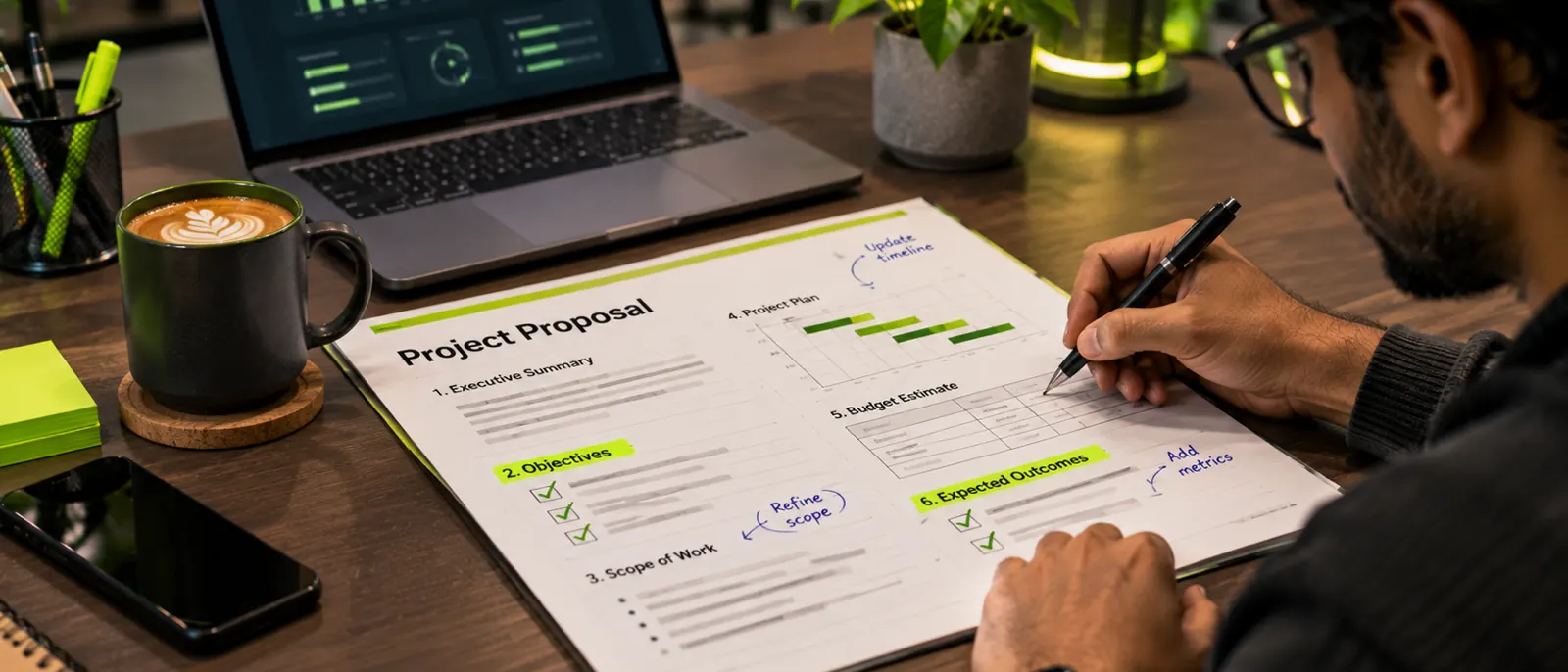
An AI agent development proposal is the document that turns "we should use an agent for this" into something a budget holder can approve and a delivery team can build. It says what the agent will do, what it will not do, how you will know it works, what it costs to build and run, and who owns the result.
We write these for clients every month, and we also read proposals other agencies send to clients who ask us for a second opinion. The good ones are surprisingly similar, and the weak ones tend to miss the same few sections. Below is what to include, a template you can copy, and what to look for when you are comparing proposals.
Who this is for
- Buyers who have received proposals from agencies and want to know whether they are complete.
- Managers writing an internal proposal to get budget for an agent.
- Agencies and freelancers who want their proposals to answer the questions clients will ask anyway.
The thirteen sections of a good proposal
1. Summary
Three or four sentences a director can read in a minute: the task, the expected benefit, the cost and the timeline to a pilot.
2. The task and how it is done today
Describe the current process in plain steps, who does it, how often, and how long it takes. If the proposal cannot describe today's process, the team has not understood it yet.
3. What success looks like
One main measure, agreed before any work starts. For example: "70% of invoices processed with no changes by the finance team, with zero incorrect payments." Add one or two secondary measures if you need them, but resist adding ten.
4. Scope: in and out
List what the agent will handle and, just as clearly, what it will not. "Out of scope: approving payments, invoices in languages other than English and Hindi, suppliers not in the master list." This section prevents most later disputes.
5. How the agent will work
Which systems it connects to, which tools it gets, and what each tool can do. Mark which actions it can take on its own and which need a person to approve. A simple diagram helps here more than paragraphs.
6. Data and security
Which data the agent reads, where it is processed, which AI providers see it, whether it is used for training, how long logs are kept, and how access is controlled. If personal data is involved, name the law that applies, such as India's DPDP Act or the GDPR, and how the design meets it. The NIST AI Risk Management Framework is a helpful, vendor-neutral checklist for this section.
7. Testing and acceptance
How the team will build a test set from your past cases, the score the agent must reach before the pilot, and the score it must hold during the pilot before it goes live. This is the section most weak proposals skip.
8. Plan and timeline
Phases with dates or week numbers: discovery, test set, prototype, hardening, pilot with a person reviewing every output, and go-live. Each phase should end in something you can see.
9. Team
The named people who will do the work, their roles and how much of their time they will spend on it, plus the one person accountable for delivery.
10. Costs: build and run
The build cost, and how it is charged (fixed price or time and materials). Then the running costs: model usage per task or per month at your expected volume, hosting, monitoring and support. A proposal that shows only the build cost is half a proposal.
11. Ownership
Who owns the code, prompts, test sets and any fine-tuned models, and whose name the AI provider accounts are in. Ideally the answer to all of these is "you".
12. Risks and assumptions
What could go wrong and what the plan assumes. For example: "Assumes API access to the accounting system is available by week 2" or "Accuracy on handwritten invoices is unknown until tested." Honest risks are a sign of experience, not weakness.
13. After launch
Who watches the agent once it is live, how often results are reviewed, what happens when a model is updated, and what support costs.
A template you can copy
Replace the parts in square brackets. Keep it short; most good proposals for a first agent fit in four to six pages.
AI AGENT PROPOSAL: [Name of the task]
Prepared for [Company] by [Team or agency], [Date]

1. SUMMARY
[Task] currently takes [hours/week] of [team]'s time. We propose an AI agent that
[does what], aiming for [main success measure]. Pilot in [n] weeks, build cost
[amount], running cost about [amount] per month at [volume].

2. TODAY'S PROCESS
Who: [team / role]   How often: [volume per day/week]   Time per case: [minutes]
Steps: [1] ... [2] ... [3] ...
Known exceptions: [list]

3. SUCCESS MEASURE
Main: [measure and target]
Secondary: [optional]

4. SCOPE
In: [what the agent handles]
Out: [what it does not]

5. HOW IT WORKS
Systems: [list]
Tools and permissions: [tool] - [read / draft / act]
Needs human approval: [actions]

6. DATA AND SECURITY
Data used: [types]   Processed in: [region]   AI providers: [names]
Training on our data: [no / terms]   Log retention: [days]   Law: [DPDP / GDPR / other]

7. TESTING AND ACCEPTANCE
Test set: [n] past cases from [period]
Pilot entry score: [x%]   Go-live score: [y%] held for [n] weeks

8. PLAN
Week [a-b]: discovery and test set
Week [c-d]: prototype and hardening
Week [e-f]: pilot with human review
Week [g]: go-live decision

9. TEAM
[Name] - [role] - [time]   Accountable lead: [name]

10. COSTS
Build: [amount] ([fixed / T&M])
Running: models [amount/month], hosting [amount/month], support [amount/month]

11. OWNERSHIP
Code, prompts, test sets: [Company]   AI accounts in the name of: [Company]

12. RISKS AND ASSUMPTIONS
[Risk] - [how we handle it]
Assumes: [list]

13. AFTER LAUNCH
Monitoring: [who, how often]   Model updates: [process]   Support: [terms]
How to compare two proposals
Put them side by side and check the sections above one by one. In our experience the differences show up in the same places.
- Testing. One proposal names a test set and target scores. The other says "thorough QA". Prefer the first.
- Running costs. One estimates the monthly model bill at your volume. The other leaves it out. Ask the second for it before comparing prices.
- Scope out. A proposal with a clear "out of scope" list is easier to hold to account.
- Ownership. Check who owns the code and the AI accounts. A cheaper proposal can be expensive if you cannot leave.
- Risks. A proposal with no risks listed has either not thought about them or is not telling you.
If you are still choosing between agencies, our checklist for choosing an AI agent development company covers the questions to ask alongside the proposal.
Red flags in an AI agent proposal
- A fixed price with no discovery phase and no description of today's process.
- Accuracy promised as a number with no test set behind it.
- "Full automation" with no approval steps anywhere.
- A platform licence you must keep paying to use what was built for you.
- No named people, only "our expert team".
FAQ
What is an AI agent development proposal?
It is a document that describes an AI agent project before it starts: the task, scope, how the agent will work, data and security, testing, timeline, team, build and running costs, ownership and risks.
How long should an AI agent proposal be?
For a first, narrowly scoped agent, four to six pages is usually enough. Longer is not better if the key sections are missing.
Should the proposal include running costs?
Yes. Model usage, hosting, monitoring and support continue after launch and can exceed the build cost over a year. Ask for an estimate at your expected volume.
Can I use this template for an internal budget request?
Yes. Fill in what you know, mark the rest as assumptions, and use the discovery phase to confirm them.
Want a proposal in this format?
Tell us the task you have in mind and roughly how often it happens. We will come back with a proposal that covers every section above, including running costs and the cases where an agent is not the right answer. Send us your task, or read about our AI agent development services first.